24/7 Emergency Service Open 7 days · 7am–8pm Serving Springfield, MA & nearby
(413) 558-8450
Springfield, MA

The Noises Your Springfield Garage Door Is Trying to Tell You

A guide for Springfield homeowners on decoding garage door noises, tied to the city's 1938-1989 housing stock and severe cold winters that stress original hardware.

The Noises Your Springfield Garage Door Is Trying to Tell You

The Situation

Most houses across Springfield neighborhoods like East Forest Park, Sixteen Acres, Forest Park, and Indian Orchard went up between 1938 and 1989, with the bulk of that stock dating to the 1960s and 70s. That matters because a door bought and installed on a 1965-built house has had roughly six decades of freeze-thaw cycles working on the same torsion spring, the same tracks, and often the same original hardware nobody upgraded when they replaced the door panels. A noise on a door like that isn't random. It's usually the sound of a specific part reaching the end of what six decades of Massachusetts winters will let it do.

A grinding sound on a door installed in a 1970s Sixteen Acres colonial almost always points somewhere different than the same grinding sound would point to on a door bought in 2015. Age and metal fatigue change what's likely, and in a city where a large share of the housing stock sits in that same age band, the same short list of failures shows up again and again in Springfield calls: dry rollers, a spring that's lost tension, or a track pulled slightly out of plumb by a foundation that's settled over sixty-plus years.

Checking It Yourself

Start with your ears while the door is moving, not after. A rhythmic thump every few feet as the door travels usually means a flat spot on a roller, common on doors that have been running the original steel or nylon rollers since a 1960s or 70s install and never had them swapped. A sharp metallic pop, once, right as the door starts to lift, is more often a spring under stress - and on a house with original 1960s hardware, that spring has likely never been replaced.

A squeal that rises and falls with the door's speed is friction, not damage - usually a dry hinge or roller. That one you can often quiet yourself with a lubricant made for garage doors, applied to the hinges, rollers, and the spring itself, not the track. A grinding or scraping sound that doesn't change with speed is different: that's metal on metal somewhere in the opener or a track that's shifted out of alignment, and it's not a lubrication fix.

One honest limit here: if the noise comes from inside the opener motor housing itself, a rattle or a whine that doesn't track with the door's movement, there's no home check for that. Openers on a lot of these older Springfield houses have been replaced once or twice since the original build, and a motor issue on any of them needs a hands-on look, not a guess from the sound alone.

The Common Mistake

The mistake we see most in Springfield is homeowners treating every noise as a lubrication problem, because that's the cheapest fix and it's the one every online article leads with. On a door original to a 1960s or 70s Springfield build, that approach buys a few quieter weeks and then the same noise comes back louder, because grease doesn't fix a spring that's lost tension or a roller that's cracked, it just masks the sound of both.

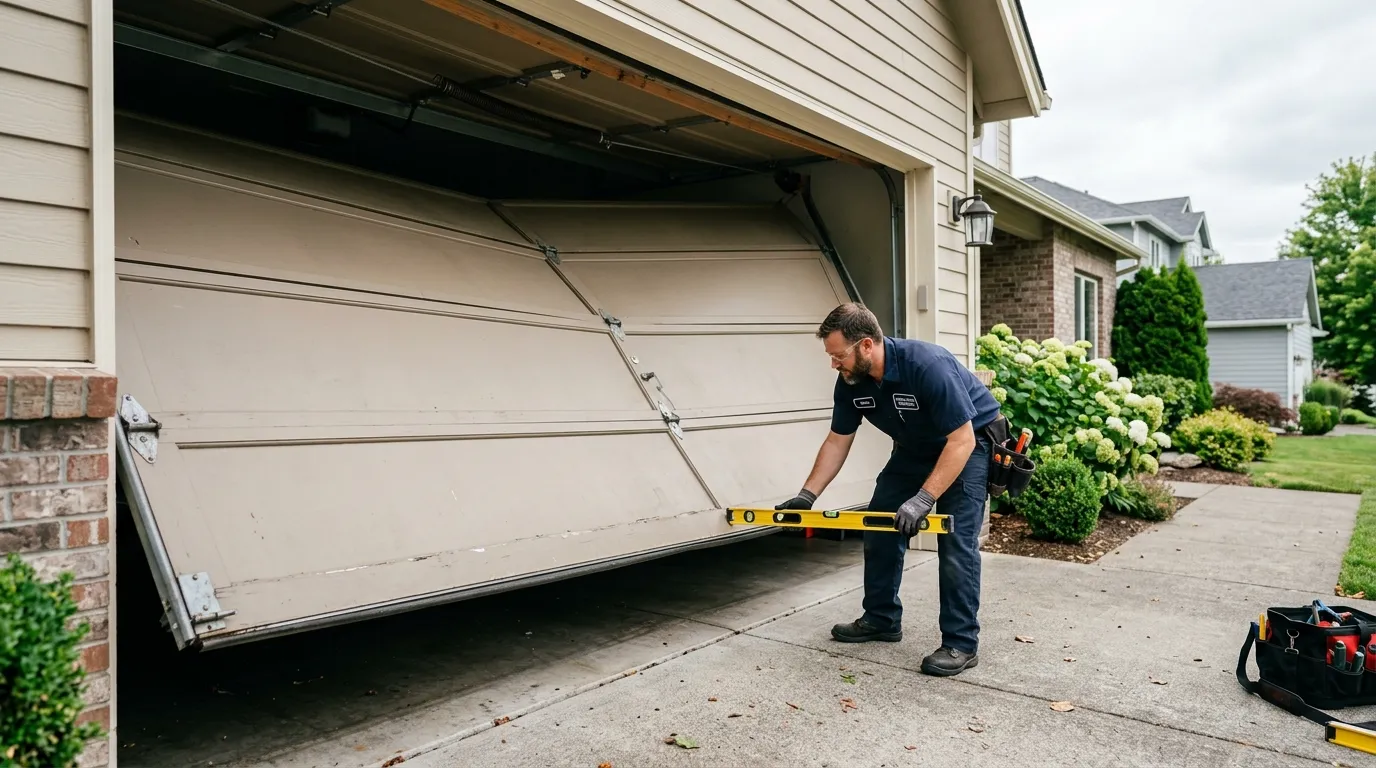
The second version of this mistake is the reverse: assuming a noise means the whole door needs replacing when it's actually one part. Given how many houses in this service area carry doors and hardware from that same 1938-1989 build window, we get plenty of calls where the panel and track are fine and it's a single spring or a pair of rollers doing all the complaining. Replacing a door over a $30 part is money spent for no reason.

We won't tell you a repair is the answer when it isn't. If a door is old enough that finding a matching panel means a special order and a long wait, or if the track has rusted through rather than just needing lube, replacement is the honest call, and we'll say so instead of nursing something that's done.
What the Weather Here Does to It

Springfield sits in a severe cold climate band, and that changes what a noise means depending on the season. Steel contracts in deep cold, and on a torsion spring that's already fatigued from decades of use, that contraction is often what turns a quiet weakness into an audible pop or a sudden loud bang as the spring finally lets go. Calls for spring failure in this area cluster in the coldest stretches of the year for exactly that reason.

Cold also stiffens the lubricant already on your rollers and hinges, so a door that ran quiet in October can start squealing in January purely from temperature, not new wear. That's worth knowing before you assume something broke overnight - sometimes it's just cold grease.

Humidity swings between seasons here also affect wood-framed openings and the panels themselves on older doors, which can shift slightly and change the sound a door makes as it seats into the frame. On a house with an opening framed in the 1960s or 70s, decades of that seasonal swelling and shrinking is often the real reason a door that was silent for years suddenly isn't.

How it works

From “it’s stuck” to “it’s fixed”

  1. 1
    Tell us what’s wrong - Springfield garage door service

    Tell us what’s wrong

    Describe the symptom - won’t open, loud bang, opener runs but the door won’t move.

  2. 2
    On-site diagnosis - Springfield garage door service

    On-site diagnosis

    A technician tests the door under power and by hand and finds what actually failed.

  3. 3
    Clear, up-front plan - Springfield garage door service

    Clear, up-front plan

    You get the fix that’s needed and what drives the cost - before any work starts.

  4. 4
    Repaired & tested - Springfield garage door service

    Repaired & tested

    The repair is done, the door is set true and tested, and the work area left clean.

Serving Springfield, MA - tell us what your door’s doing and we’ll take it from there.

40areas covered
How we work

What to expect

Diagnosis firstEvery visit starts by finding what actually failed - not a pre-written parts list.
The right part for the doorSprings and openers matched to the door’s weight and age, so the fix holds up.
Straight answersWhen a repair makes more sense than a replacement - or the reverse - you hear it plainly.
Clean, careful workTension released safely, hardware set true, the door tested under power before we leave.
Questions

Frequently asked

Straight answers about garage door repair in Springfield. Still unsure? Ask us directly.

Why does my garage door make a loud bang only in winter?

That's almost always a torsion spring, and cold makes it worse. Steel contracts in low temperatures, and a spring that's already fatigued from years of cycling is more likely to fail outright in a cold snap than in warm weather. Springfield's severe cold winters push failing springs past their limit faster than a milder climate would.

My door squeals but only sometimes - is that serious?

A squeal that comes and goes with temperature is usually just stiff lubricant on rollers or hinges, not damage. It's more common in older Springfield homes where the hardware has been through many freeze-thaw cycles. Try a garage-door-specific lubricant on the moving metal parts first before assuming a part has failed.

Is a grinding noise always the opener?

Not always. Grinding that changes with the door's speed often points to a track that's shifted out of alignment, which is common in homes built in the 1938-1989 window as foundations settle over decades. Grinding from inside the motor housing itself is a different problem and needs a hands-on look, not a guess from sound.

Ready to get your garage door sorted?

Tell us what it’s doing and where you are in Springfield - we’ll take it from there.

Request a QuoteCall